

Hyperbaric Oxygen Therapy
“What Hyperbaric Oxygen Therapy Is – How It Works”
Hyperbaric Oxygen Therapy (HBOT) is a highly effective therapeutic intervention in modern medicine, during which the patient breathes 100% oxygen at an ambient pressure greater than 1 atmosphere. The treatment is carried out inside a state-of-the-art multi-place hyperbaric chamber accommodating up to 12 seated patients.
Hyperbaric Oxygen Therapy is the only therapeutic approach in medical science that achieves, among other effects:
- Hyperoxygenation – Reversal of Tissue Hypoxia
- Ensured oxygenation of damaged tissues, overcoming barriers to blood flow and oxygenation caused by edema, hematoma, destruction or obstruction of small blood vessels.
- Ensures oxygenation of tissues with reduced blood flow, as occurs in patients with diabetes, irradiated areas, and tissues that have undergone multiple surgical procedures.
- Oxygenates tissues that normally have relatively low blood circulation, such as cartilage, tendons and ligaments.
- Increases oxygen concentration (VO2 max) for up to 3 hours after treatment.
- Anti-inflammatory and Immunomodulatory Effects
- Prevents the adhesion of white blood cells to the endothelium (the inner lining) of blood vessels, specifically to ICAM-1 receptors, thereby interrupting the inflammatory cascade.
- It has been shown that after a single Hyperbaric Oxygen session, more than 4,000 inflammation-promoting genes are suppressed, while more than 4,000 anti-inflammatory, healing and growth-related genes are expressed. For example, anti-inflammatory cytokines increase while pro-inflammatory cytokines decrease.
- Anti-edema Effect
- Produces an internal anti-edema effect through the natural vasoconstrictive response to peripheral normoxia or hyperoxia, increasing blood-flow velocity.
- Restoration of normal blood supply to affected tissues through the formation of new small blood vessels, as a result of stimulation of Vascular Endothelial Growth Factor (VEGF).
- Promotion of tissue healing
- Through stimulation of fibroblasts and promotion of the synthesis and maturation of collagen fibers (collagenogenesis).
- Through activation of osteoblasts (bone formation) and chondroblasts (cartilage formation), resulting in osteochondral regeneration.
- Through increased proliferation of myoblasts (formation of muscle fibers).
- Ensured aerobic glycolysis (aerobic metabolism)
- Promotes cellular energy production, including ATP production, and consequently supports proper cellular function and metabolism.
- Accelerates the clearance of by-products of anaerobic metabolism, such as lactic acid and ammonia. It has been shown that lactic acid may decrease by 70% after a single treatment.
- Stimulation of stem-cell proliferation and mobilization by up to eightfold following a course of twenty Hyperbaric Oxygen sessions (S. Thom, 2006).
- Bactericidal activity against anaerobic microorganisms and bacteriostatic activity against aerobic microorganisms and fungi.
“The Role of Hyperbaric Oxygen Therapy in Orthopaedics”
Hyperbaric Oxygen Therapy has well-known and established effects and recognized indications. In Orthopaedics, it is applied in:
- Compartment Syndrome and Crush Injury Syndrome.
- Chronic Recurrent Osteomyelitis. The complete treatment rate reported in the literature reaches 91% when combined with antibiotic therapy and surgical intervention.
- Acute traumatic ischemia and open fractures with extensive soft-tissue injury and vascular damage (Gustilo IIIb/IIIc classification). Complications such as amputation, delayed or incomplete bone union and infections may be avoided, while the success of grafts may be improved.
- Non-union and Delayed Union of Fractures. A complete healing and bone-union rate of up to 90% has been reported. In cases requiring surgical intervention, combining surgery with Hyperbaric Oxygen Therapy may help support a successful outcome.
- Bone edema and Stage I–IIB Avascular Necrosis. The complete treatment rate is reported to reach 92%.
- Recovery following orthopaedic procedures involving, for example, the meniscus, cartilage and tendons, with a reduction in recovery time of up to 60%. It is widely used to promote recovery in “compromised tissue environments,” particularly where healing mechanisms are impaired in patients with diabetes, immunosuppression or multiple previous operations.
- A key therapeutic factor in chronic inflammation and injuries, aiming to ensure faster recovery. Such conditions include muscle strains and hematomas, tendinitis involving the Achilles tendon or supraspinatus, shin periostitis, stress fractures, elbow epicondylitis and ligament injuries.
- Faster and more reliable recovery from sports injuries. Recovery time may be reduced by more than half, with a reported 55% reduction in sprains, ligament injuries and muscle strains.
- Improves strength and endurance and helps recovery from fatigue related to sports and elite athletic performance. For these reasons, Hyperbaric Oxygen Therapy is used by elite athletes and teams, as it may contribute to improved athletic performance and injury prevention by optimizing recovery between training sessions and competitions.
- Multiplicative and synergistic action when Hyperbaric Oxygen Therapy is combined with regenerative orthopaedic treatments such as PRP, PRF, stem cells, hyaluronic acid, collagen, enzymes and others, for the treatment of myotendinous, ligamentous and osteochondral conditions.
- Regenerative treatment of articular cartilage lesions of traumatic or degenerative origin, including osteoarthritis, through combinations of Hyperbaric Oxygen Therapy, stem cells, growth factors and other treatments. This approach aims to treat bone edema or inflammatory findings, ensure blood supply to the region through the formation of new blood vessels, promote cartilage formation by improving oxygenation and blood flow, and increase stem-cell numbers and mobilization by up to eightfold.
“How It Differs from Current Therapeutic Approaches”
Hyperbaric Oxygen Therapy represents a cornerstone of modern treatment, with healing, regenerative and anti-inflammatory effects that have been documented for many years. Important advantages of Hyperbaric Oxygen Therapy include:
- The administration of 100% oxygen in an environment with pressure greater than normal atmospheric pressure means that the effects of hyperbaric oxygen can reach tissues despite certain barriers. In this way, it acts therapeutically at the “root of the problem” by addressing underlying physiological mechanisms. A pharmaceutical substance or an externally applied treatment may not adequately reach the area of interest because of edema, vascular damage or tissue characteristics, whereas oxygen, as a gas under hyperbaric conditions, can penetrate and exert its effects.
- The body’s defense, repair and reconstruction mechanisms are oxygen-dependent. The basis of Hyperbaric Oxygen Therapy is to support and promote these mechanisms.
- The use of Hyperbaric Oxygen Therapy may reduce the need for therapeutic approaches intended to stimulate a healing response through tissue irritation, such as bone drilling, glucose injections and similar methods.
- Hyperbaric Oxygen Therapy has a synergistic and potentially amplifying effect when used together with regenerative approaches such as PRP, PRF and stem-cell therapies.
- It supports the success of surgical procedures by preparing the tissue environment and helping remove obstacles to healing, such as edema and hematoma. This may allow the inflammatory phase to resolve more rapidly in favor of the healing phase, which Hyperbaric Oxygen Therapy helps promote.
- Whereas many therapeutic approaches are applied and then depend on the body’s subsequent response, Hyperbaric Oxygen Therapy is intended to directly promote the biological mechanisms involved in healing.
Questions
1. How does it provide the best therapeutic results in the shortest possible time?
Because it is based on a treatment plan that uses the most effective therapeutic methods at the appropriate time, according to the stage of the condition, while at the same time diagnosing and treating secondary consequences as well as the deeper underlying causes that led to the condition.
2. How do I know whether I am suitable for the treatment plan?
In order to develop an appropriate personalized treatment plan, an in-person clinical examination and assessment of the patient’s medical history, the specific condition and overall health status are recommended.
Alternatively, you may follow the steps of the first Online Appointment.
3. Is this a type of alternative therapy?
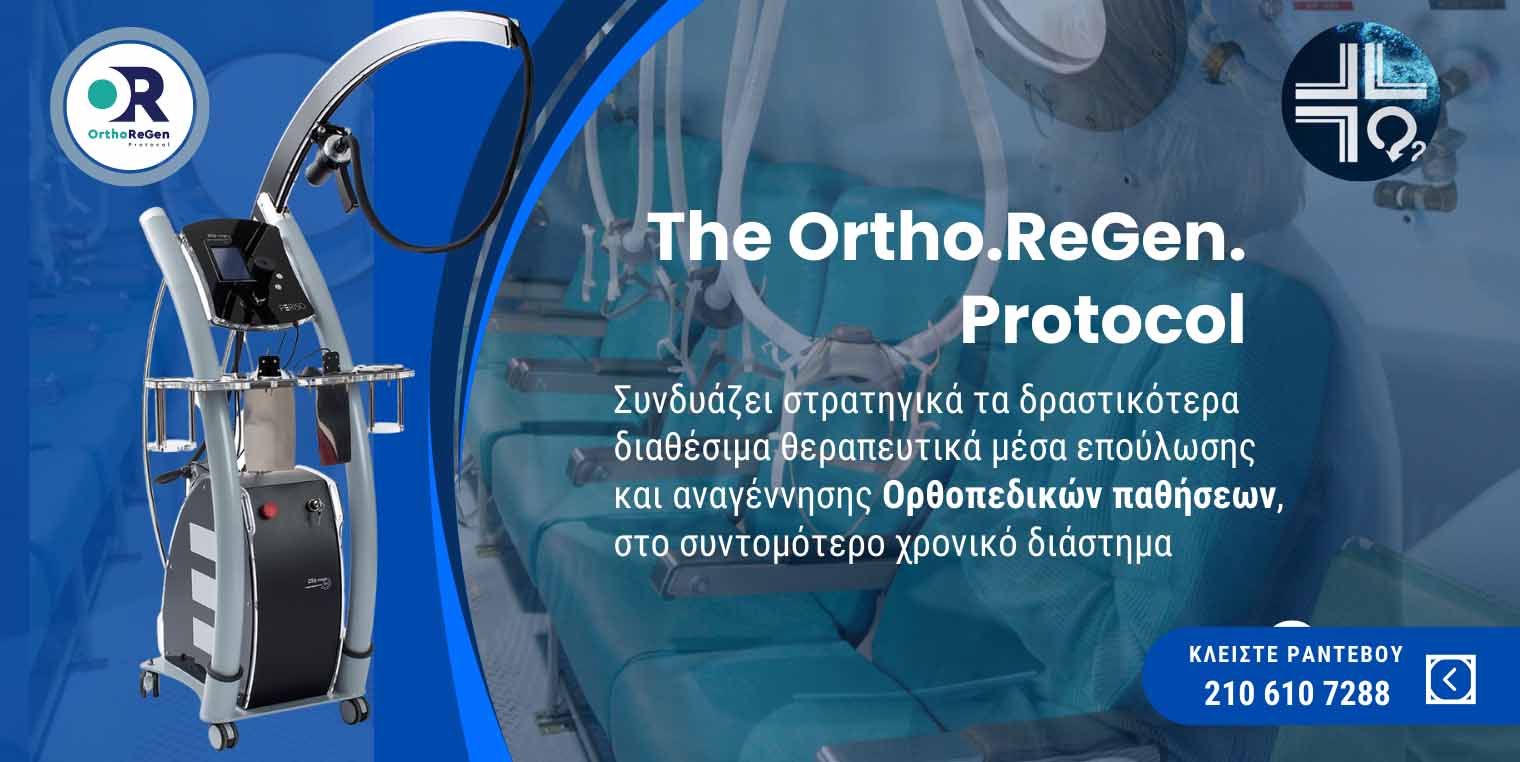
The Ortho.ReGen. Protocol is not a single treatment. It is a therapeutic plan within Regenerative Orthopaedics that appropriately combines some of the most effective therapeutic and rehabilitation methods available in medical science, adapting them to the individual patient and condition in order to achieve complete recovery in the shortest possible time.

